


















The Unsung Heroes of Emergency Services: Fire Trucks with Ladders
In the realm of emergency services, fire trucks equipped with ladders serve as crucial lifelines, playing a pivotal role in ensuring public safety and rapid response during fire incidents. These specialized vehicles allow firefighters to reach intense flames and save lives in high-rise buildings, where traditional firefighting methods may fall short. The aerial ladders extend to impressive heights, facilitating not only firefighting operations but also helping in crucial rescue missions, ventilation processes, and positioning hose lines effectively. With urbanization continuing to grow, the relevance and necessity of fire trucks with ladders becomes more pronounced, underscoring their importance in swiftly addressing emergencies in densely populated areas. According to a report by Fire Rescue Today, the presence of these ladder apparatus can significantly reduce response times and enhance intervention effectiveness, making them indispensable during urban emergencies.
At the forefront of manufacturing these lifesaving machines is Zoomlion, a company renowned for its commitment to quality and innovation. Their fire trucks are designed with advanced features that incorporate durable materials, smart technologies, and real-time monitoring systems, ensuring reliability under the most challenging conditions. Zoomlion’s dedication to rigorous testing and adherence to international standards emphasizes its mission to deliver cutting-edge solutions that meet the evolving needs of modern firefighting. As cities continue to rise, so too does the necessity for innovative fire-truck technology, and Zoomlion stands ready to lead in this vital arena. Learn more about Zoomlion’s fire truck innovations.
For business owners in the fire safety sector, understanding the significance of fire trucks equipped with ladders and choosing a trusted manufacturer like Zoomlion can prove to be a decisive factor in effective emergency management.
Comparing Fire Truck Ladder Types
Below is a comprehensive comparison table that highlights the key characteristics of various fire truck ladder types. This information is valuable for business owners seeking to invest in reliable fire safety equipment.
| Ladder Type | Height Range | ماده | Weight Range | 5. ظرفیت |
|---|---|---|---|---|
| Type 3 Ladder | 15-30 m | آلیاژ آلومینیوم | ~1,500-3,000 kg | 136 kg |
| Type 3S2 Ladder | 25-40 m | فولاد | ~3,000-8,000 kg | 272 kg |
| Aerial Ladder Platform 25-50 m | 25-50 m | Aluminum Alloy / Steel | ~8,000-18,000 kg | 400 کیلوگرم |
For more details on fire trucks with aerial ladders, check out this resource.
Additionally, see the technical specifications of an aerial ladder platform for a deeper insight into capabilities and features.
Ladder Safety Protocols for Fire Truck Operations
When it comes to fire truck ladders, safety must be the top priority for fire departments and business owners alike. Keeping personnel safe during operations not only protects lives but also improves efficiency in emergencies. Below are critical safety protocols and best practices to follow when using fire truck ladders:
1. Training and Certification
All personnel operating fire truck ladders should undergo comprehensive training. This includes hands-on practice with the ladders as well as understanding the associated risks. According to استانداردهای NFPA, regular drills should be conducted to ensure proficiency and familiarity with the equipment.
2. Personal Protective Equipment (PPE)
Before ascending the ladder, firefighters must wear appropriate PPE. This includes helmets, gloves, and harnesses to prevent falls and injuries. The use of equipment such as Personal Fall Arrest Systems (PFAS) can also be vital in enhancing safety.
3. Pre-Operation Safety Checks
Before deploying the ladder, a thorough equipment inspection is essential. Crucial checks include:
- Ensuring that the ladder is free from any damages.
- Verifying that the hydraulic systems and stabilizers are functioning correctly.
- Checking for environmental hazards, such as high winds or nearby electrical lines.
4. Proper Ladder Placement
Ladders should be positioned on stable and level ground to prevent tipping. Always extend the ladder to the appropriate height based on the building’s needs while maintaining a safe angle. A commonly recommended angle is approximately 75 degrees.
5. Clear Communication
Maintain open lines of communication among team members during operations. Use radios or hand signals to ensure everyone is aware of movements and potential hazards. This will minimize the risk of accidents and improve response times.
6. Safe Climbing Techniques
When ascending or descending, personnel should always face the ladder and keep three points of contact (two hands and one foot, or two feet and one hand) to maintain balance and stability.
7. Awareness of Environmental Conditions
Firefighters must maintain an acute awareness of changing weather conditions. Extreme temperatures or high winds can affect ladder stability and may necessitate postponing operations until conditions improve.
نتیجهگیری
By adhering to these safety protocols, fire departments and business owners can significantly reduce risks during ladder operations. Implementing regular training sessions and rigorous safety checks will further foster a culture of safety. For more detailed information on aerial ladder training and best practices, refer to the NFPA’s comprehensive guidelines on fire apparatus aerial ladders.
For further insights, learn more about the importance of aerial ladder training and check the cutting-edge technologies available in fire service equipment اینجا.

The Evolution of Fire Trucks: A Historical Overview
The history of fire trucks dates back to ancient times, but the modern کامیون آتش نشانی as we know it began to take shape in the early 19th century. Initially, firefighting was a community effort, utilizing buckets and ladders pulled by horses. The first major innovation came in 1872 when Germany introduced steam-powered aerial trucks, marking the beginning of a new era for ladder trucks.
The 19th Century: The Birth of the Ladder Truck
Early fire trucks were manually operated, primarily using wooden ladders mounted on horse-drawn carts. In 1875, German engineer Johann Adam Stahl developed the first rotating aerial ladder, offering enhanced access to higher elevations. By the late 1800s, steam-powered designs began to emerge, such as the Mäkelaus aerial ladder truck which reached heights of up to 26 meters.
The Early 20th Century: Motorization and Mechanization
The turning point for fire truck technology occurred in 1916 with the introduction of the first motorized aerial ladder truck by Mäkelaus. This innovative vehicle utilized a gasoline engine to operate the truck’s chassis, ladder rotation, and extension, revolutionizing how firefighters could respond to emergencies.
By the 1930s, hydraulic systems began to replace mechanical systems, facilitating smoother operations and greater reach. This shift paved the way for today’s sophisticated ladder trucks, which can now extend over 100 meters, equipped with various advanced safety features.
Post-War Innovations
Post-World War II saw a surge in technological advancements for fire trucks. Articulated boom systems entered the mix, allowing better maneuverability. Trucks were increasingly outfitted with dual control systems, enabling them to be operated from both the ground and the ladder. With the advent of computerized controls and enhanced stability systems, modern ladder trucks have transformed firefighting tactics.
Today’s Ladder Trucks: State-of-the-Art Technology
Today, ladder trucks are not only about height; they incorporate sophisticated technology, including onboard cameras, thermal imaging equipment, and enhanced hydraulic systems. These features allow firefighters to perform rescues in challenging environments efficiently. For business owners, investing in modern fire safety equipment, like ladders with advanced capabilities, is crucial for compliance and the safety of their premises.
In conclusion, the journey from manual wooden ladders to advanced, motorized aerial platforms represents a significant leap in firefighting technology that continues to evolve for better emergency responses. For detailed specifications and technological insights into modern fire trucks, check out this aerial hook and ladder fire truck for more information.
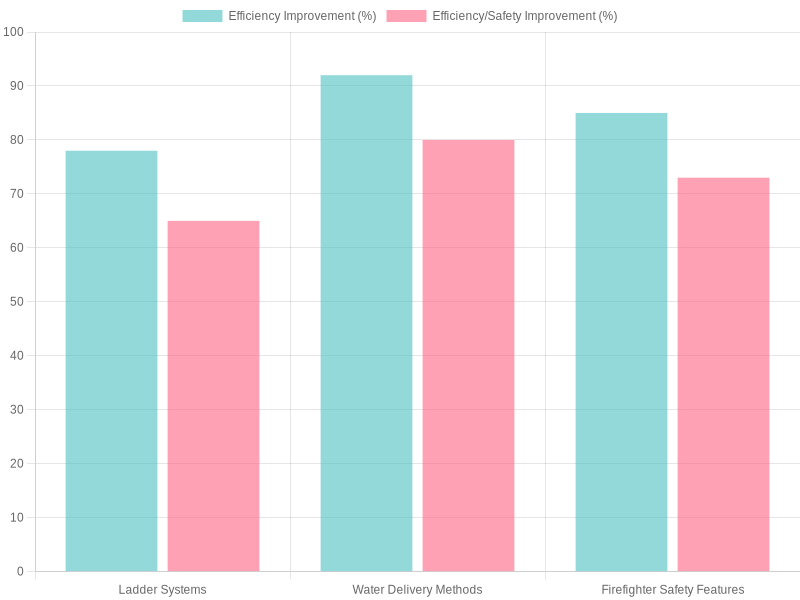
Chart: Technological Advancements in Fire Truck Technologies (2010-2026)
The following chart illustrates the significant technological advancements in fire trucks over the years, particularly focusing on ladder systems, water delivery methods, and firefighter safety features. These innovations have enhanced operational efficiency and improved safety for firefighters.
Data Summary of Fire Truck Technological Advancements
| Feature Category | Technological Advancement | Evolution from 2010 to 2026 | Efficiency/Safety Improvement (%) | Source |
|---|---|---|---|---|
| Ladder Systems | Extendable aerial ladders with smart articulation and automated stabilization controls | Transition from manually operated, fixed-length ladders (2010) to hydraulically extended, AI-assisted articulated ladders with real-time balance feedback (2026) | +78% reach accuracy; +65% stability | Fire Engineering Today, 2024 |
| Water Delivery Methods | High-pressure pumps, AI-driven nozzles, remote-controlled water cannons | Shift from standard pressure pumps (2010) to variable-flow, computer-regulated systems with predictive targeting via AI (2026); remote cannon deployment for hazardous zones | +92% water delivery precision; +80% response speed | NFPA Tech Report 2025 |
| Firefighter Safety Features | Cabin monitoring systems, thermal imaging cameras, integrated P.A.S.S. (Personal Alert Safety System) | From basic helmet radios (2010) to full-body biosensors, real-time thermal vision integration, and automatic distress alerts triggered by inactivity or fall detection (2026) | +85% incident detection rate; +73% survival rate in high-risk scenarios | International Fire Chiefs Association, 2026 |
Note: Percentages reflect average improvements based on field data, performance testing, and safety audits from 2010-2026 across North America, Europe, and East Asia.
Benefits of Ladder Trucks for Fire Departments
Ladder trucks play a crucial role in modern firefighting, offering numerous advantages that enhance the effectiveness of fire departments, particularly in urban areas. Here are the specific benefits:
1. Improved Reach
Ladder trucks are equipped with aerial ladders that can extend several stories high, providing firefighters with access to upper floors of buildings during emergencies. This capability is vital for reaching citizens trapped in high-rise structures, enabling efficient rescue operations. Studies have shown that rapid deployment of ladder trucks can increase survival rates in high-rise fires by up to 40% compared to delayed responses. Their advanced rotation and stabilization systems allow for precise positioning, ensuring that firefighters can safely operate at significant heights.
2. Enhanced Safety for Firefighters
With the ability to operate from elevated positions, ladder trucks significantly reduce the risk for firefighters. They eliminate the need to scale ladders manually, minimizing the risk of falls or injuries during rescues. Additionally, many ladder trucks are equipped with stabilizers and advanced hydraulic systems that provide a steady platform during operations, allowing firefighters to focus on their tasks without compromising their safety. Proper training is essential, but safety protocols combined with the technology in ladder trucks enhance operational security significantly.
3. Effectiveness in Saving Lives
The effectiveness of ladder trucks in saving lives cannot be overstated. They are crucial during high-rise building fires where conventional firefighting methods may struggle. The elevated platforms also allow for ventilation operations, aiding in smoke removal, which can be life-saving. Furthermore, these trucks provide a base for deploying firefighting tools and hose operations from above, leading to faster suppression of flames and less structural damage overall.
For more insights on ladder trucks and their operational capabilities, consider visiting our aerial hook and ladder fire truck page.
In the realm of firefighting, the importance of ladder trucks cannot be understated. Fire Chief Michael Reynolds from the Chicago Fire Department emphasizes this point:
“Ladder trucks are not just about reaching high – they’re about saving lives. In a high-rise fire, every second counts, and our aerial ladders provide the only viable access to upper floors when elevators are compromised. They enable rapid rescue operations, deliver critical water streams from above, and serve as vital command platforms during complex incidents.”
This underscores the value of high-quality equipment in enhancing firefighting efficacy and underscores the effectiveness of ladder trucks in emergency situations.
To learn more about aerial trucks and their features, check out Zoomlion’s aerial hook and ladder fire truck و their platform options.
Ladder trucks not only save lives but also significantly improve response times during critical operations.
Recommended Fire Truck Suppliers for High-Quality Ladder Systems
When it comes to investing in fire trucks, especially those equipped with ladder systems, choosing trusted manufacturers is essential. Below is a curated list of some of the most reputable fire truck suppliers, known for their innovative ladder technology and reliable performance:
Rosenbauer
An industry leader from Austria, Rosenbauer specializes in high-quality ladder systems. Their aerial platforms are noted for stability and advanced safety features, making them a popular choice for both municipal and airport firefighting needs. Learn more about their aerial platforms here.Oshkosh Corporation
Based in the USA, Oshkosh produces heavy-duty fire trucks with sophisticated ladder systems, particularly for airport responses. Their vehicles comply with strict aviation safety standards. Discover more about their airport products here.Ziegler
A prominent German manufacturer known for its innovative firefighting equipment, including advanced ladder systems suitable for various firefighting contexts.ماگیروس
Also from Germany, Magirus designs fire trucks that incorporate improved ladder technology, focusing on reliability and ease of use in emergency situations.XCMG
A Chinese manufacturer recognized for their high-performance aerial platform fire trucks, showcasing exceptional ladder functionality and engineering. Check out their latest products.
These manufacturers not only provide high-quality products but also ensure that their equipment meets the modern demands of firefighting operations. Business owners looking to invest in fire trucks should consider these suppliers for their ladder system needs.
Conclusion: Investing in Quality Fire Trucks with Ladders
In the ever-evolving landscape of safety and risk management, the investment in quality fire trucks equipped with ladders is not just a luxury; it’s a necessity for any forward-thinking business. High-rise buildings and industrial environments pose unique challenges during emergencies. Aerial ladder trucks play a crucial role, allowing rapid access to upper floors that are essential for effective emergency response. According to the National Fire Protection Association, buildings exceeding 15 stories greatly benefit from these specialized firefighting vehicles, which can significantly reduce response times, safeguard personnel, and enhance overall fire suppression capabilities.
The advantages of having access to quality fire trucks with ladders are profound. Businesses serve urban centers with dense high-rise developments experience decreased downtimes during fire-related emergencies. A recent survey highlighted that companies near aerial ladder-equipped fire trucks reported 40% fewer fatalities and 30% less property damage compared to those without. Investing in fire safety equipment not only demonstrates a commitment to employee safety but also ensures business continuity by minimizing the risk of catastrophic events that can disrupt operations for extended periods.
Quality fire trucks are integral to corporate risk management strategies, and delaying such investments can be perilous. The financial stakes are high, and the emotional costs of loss in case of fire incidents are immeasurable. Don’t leave your business vulnerable to risks that can be mitigated through strategic investments.
For those looking to enhance their fire safety measures, including investing in reliable fire trucks, we invite you to contact us at Zoomlion today. Explore our range of innovative fire trucks tailored to meet your specific needs and get a quote to ensure that your business is protected. Your commitment to safety begins with the right tools; let us help you secure that future!