

















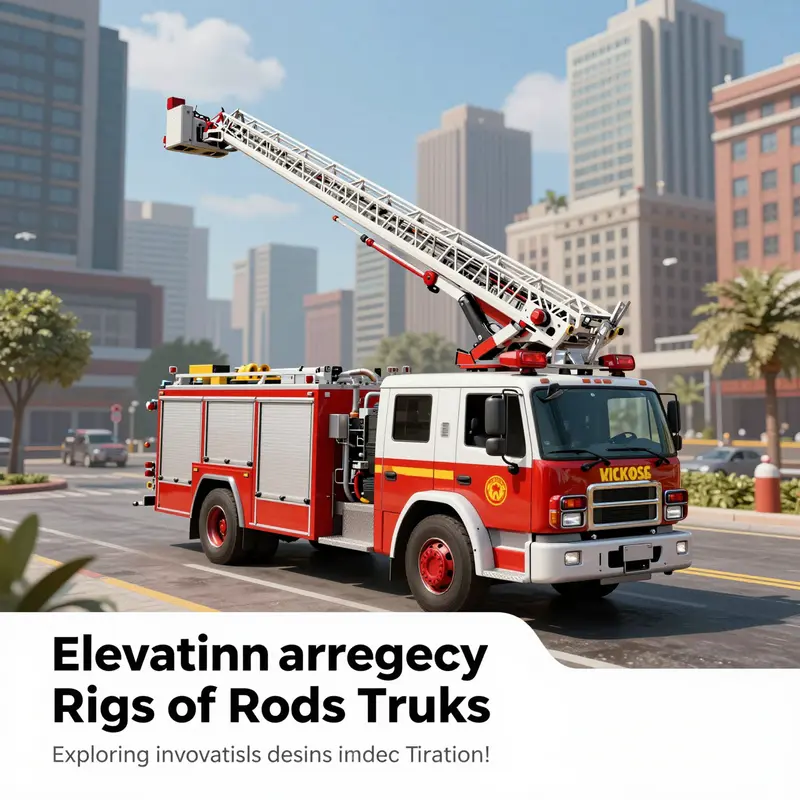
The world of vehicle simulation is evolving, and Rigs of Rods stands at the forefront with its emphasis on realistic physics and community-driven customization. In particular, ladder fire trucks serve as a compelling vehicle type that combines utility with excitement in gameplay. This article delves into the intricacies of designing these trucks within Rigs of Rods, examining their functional mechanics, exploring real-world applications of their simulations, and celebrating the contributions of the community in crafting unique models. Through each chapter, business owners can gain insights into leveraging the capabilities of Rigs of Rods for training, planning, and operational strategies.
Raising Reach and Realism: Crafting Ladder Fire Truck Models in Rigs of Rods
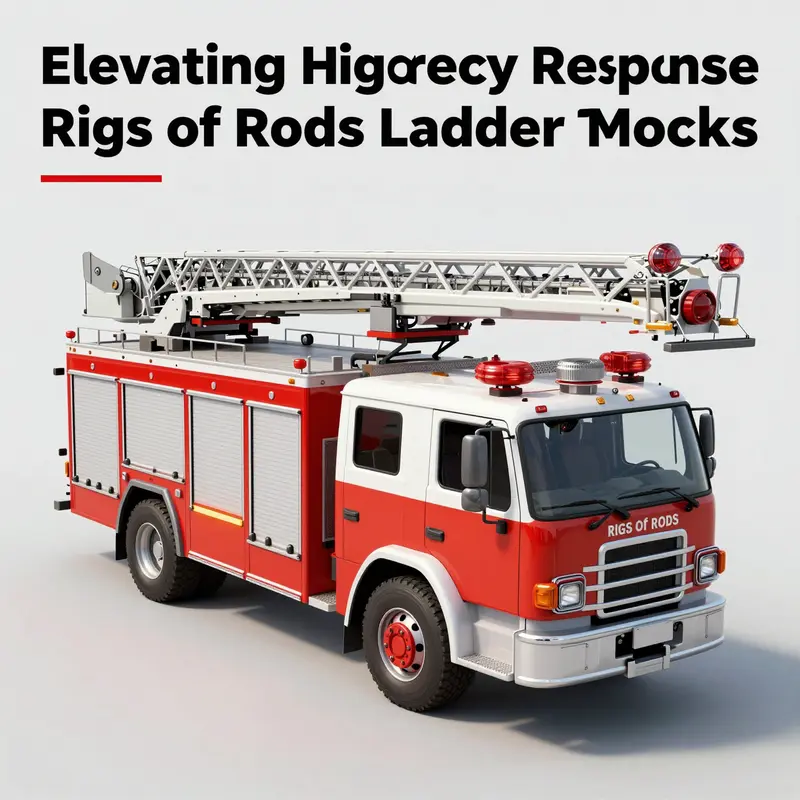
The ladder fire truck is a study in reach, balance, and responsive physics, a vehicle that remains demanding to model even as the rules of the game reward fidelity. In Rigs of Rods, the engine that governs a ladder truck is not a single rigid unit but a tapestry of interconnected nodes, rods, hinges, and hydraulic actuators. The core idea is to mirror how a real aerial platform behaves when it extends, twists, and bears weight while keeping enough headroom for the user to experiment with real-world scenarios. The open-source nature of the platform invites builders to approach realism not as a single blueprint but as a living system, where every new joint or segment can be tested, tuned, and rebalanced. This makes the ladder truck in RoR more than a static model; it becomes a dynamic tool for exploring how weight distribution, wind forces, and hydraulic response interact under stress. The project begins with a clean slate: the chassis and cabin form the base, but the real challenge lies in the ladder boom, its rotation, its extension, and the way those elements interact with the vehicle’s suspension and tires as terrain changes beneath them.
At the structural level, the ladder truck is built from a chassis that supports a cabin, and mounted to that frame is a telescoping or articulated ladder boom. In RoR’s physics, every component is a collection of rigid bodies linked by flexible joints—the very system that enables deformations and controlled collapses under load. Designing the ladder boom means planning for multiple segments that can slide past one another, yet remain securely connected enough to carry dynamic loads. A telescopic configuration benefits from a series of nested segments, each with its own hinge and a calibrated hydraulic actuator to push or pull. An articulated boom, by contrast, relies on distinct pivot points and a set of hydraulic cylinders that permit sweeping angles and controlled arcs. Either approach requires careful attention to how each segment’s mass affects the whole, how inertia shifts as the ladder extends, and how the center of gravity migrates upward with reach. Realism hinges on balancing these forces so the ladder feels substantial yet responsive, not flimsy or floaty in the air.
The rotating turntable is where reach meets orientation. A ladder that can swivel 360 degrees around a vertical axis enables high-angle access to façades while letting operators maintain stable footing on the ground. In RoR, the turntable must be modeled as a separate horizon of movement with its own rotation constraints and damping. This ensures that a sudden extension does not overpower the vehicle’s base or overwhelm the physics engine. The turntable’s integration with outriggers is crucial for stability. Outriggers extend the footprint of the truck, distributing weight more widely to resist tipping when the ladder is at full extension or when the boom carries water or other loads. The modeling of outriggers involves hinges that allow lateral deployment, as well as contact points that grip the surface and provide a stable reaction force. The success of a ladder truck model in RoR is often measured by how well it responds to a simulated rescue scenario: the ladder reaches daring heights, the vehicle remains planted, and the ground crew can operate with predictable confidence.
The hydraulic system that powers extension, tilt, and rotation is a sophisticated interplay of force, speed, and safety constraints. In a real ladder truck, hydraulics are tuned to deliver smooth motion without overshoot, and RoR’s physics allows designers to approximate that dynamic through parameters that govern actuator strength, response time, and hydraulic leakage. For ladder extension, you typically implement a multi-segment approach where each actuator governs a particular stage. The challenge is to ensure coordinated movement across all segments so that the ladder remains straight or adheres to a desired curvature as dictated by the task. A misaligned sequence can create a wobble or bind that ruins the illusion of realism. When sculpting the hydraulics in RoR, one must also attend to the ladder’s load distribution. A ladder carrying water, tools, or a rescue basket imposes a nontrivial moment about the truck’s base. The model must simulate that moment and its effect on steering, braking, and suspension geometry. In a well-tuned model, the longer the ladder extends, the greater the demand on the outriggers, the turntable’s resistance, and the chassis’s ability to absorb the resulting torque.
A critical element of authenticity is the interaction of the ladder with environment and user input. Lua scripting, available since version 0.28, empowers the creator to choreograph movement with precision. A practical script controls deployment speed, defines a maximum reach, and enforces safety margins such as overextension warnings or automatic retraction if outriggers are not deployed. The scripting layer also enables simple interlocks to mirror real-life practice: the ladder cannot extend beyond a safe angle when the outriggers are stowed, and the ladder should retract automatically if a sudden collision or abnormal force is detected in its path. The beauty of Lua in this context lies in the ability to translate generic motion into procedural, repeatable tasks. A user can program deployment sequences that commence with a cautious, slow lift, then smoothly accelerate to full reach, with automatic deceleration as the ladder approaches its limit. The same logic can be used to model retraction, with the ladder folding back compactly and the outriggers retracting in a safe, ordered fashion.
Beyond motion, the ladder truck must feel like a working tool, not a showcase piece. Water delivery through the ladder—what crew members often call the ladder pipe—is an important functional element. In the game, a working water pump can be integrated into the hydraulic logic so that a stream of water follows the ladder into a target zone, producing visible spray and a believable pump sound. Lighting and thermal imaging add to the sense of realism and utility. A researcher or designer might script optional features that illuminate the ladder tip, turntable area, and operator cabin, allowing players to observe how light behaves on different materials and angles. Thermal imaging, while not a real-time necessity, serves as a credible aesthetic and a demonstration of how modern firefighting equipment uses sensors to assess heat sources from a distance.
Texture and material choices play a surprisingly large role in the perception of realism. The model should feature textures that reflect metal surfaces, wear on steps, and the sheen of reflective safety tape. Materials can be adjusted to evoke different environments—for instance, a dusty city street or a rain-soaked alley—without changing the fundamental geometry. When choosing textures, it is wise to avoid reliance on real-world brands, focusing instead on generic but convincing finishes. The chassis must match the vehicle’s function. A robust, slightly rugged drivetrain is appropriate for urban and semi-off-road rescue work. In some environments, a 4×4 configuration provides the necessary traction for rough terrain, while in others, a lighter 4×2 arrangement suffices for city rescues. Suspension models should respond to uneven pavement, curb gaps, and soft ground, letting the truck lean and rebound in a believable manner rather than sticking like a rigid sculpture.
The testing phase in RoR is as essential as the design phase. A ladder truck model should be exercised across three principal environments: city streets with tight corners and traffic, wooded or forested areas where the ground shifts underfoot, and open fields that expose the truck to wind forces and long-range observations. In each setting, the ladder’s extension, tilt, and rotation must feel controlled and purposeful. The ability to simulate wind gusts on a tall, exposed ladder is a notable test of the model’s resilience. The commander must be able to coordinate movement with other players in a cooperative drill, using the RoR multiplayer features. The game’s support for up to 16 players enables a realistic exercise in teamwork: someone operates the ladder, another manages water supply, and others coordinate the approach of the engine and establish a rescue perimeter. The ladder truck model thus becomes not only a mechanical exercise but a social one, inviting players to rehearse common procedures and to observe how a well-tuned system behaves when multiple decisions move in concert.
The iterative nature of such a project is worth emphasizing. Every adjustment to hinge stiffness, segment mass, or actuator speed can ripple through the entire model, altering balance, responsiveness, and perceived weight. A good practice is to approach the build in layers: first the chassis and rail of the ladder base, then the turntable mechanisms, followed by the major ladder segments, and finally the hydraulic system and safety interlocks. As the model matures, the script can grow to handle more nuanced tasks, such as automatic stabilizer deployment when the ladder reaches specific angles or automatic retraction when a collision is detected. These decisions matter because they shape the player’s experience—from the tactile feel of a sturdy, dependable platform to the sense that the vehicle is a living system capable of adapting to the unknowns of a fire scene.
In the end, the ladder fire truck model in RoR is a bridge between engineering principles and interactive exploration. It invites builders to translate real-world relationships among reach, stability, and load into a sandbox environment where experimentation is encouraged and mistakes yield immediate, visible feedback. The process rewards documentation and incremental testing: note the impact of each adjustment on center of gravity, turning radius, and ladder behavior under load. It rewards restraint as well; a model that is too aggressive in its extension curves or too aggressive in its response can feel unreliable, defeating the purpose of a rescue platform. The excitement comes not from a single spectacular extension but from the quiet confidence of a system that behaves consistently under varying conditions, letting players focus on the mission itself rather than wrestling with the machine. For those who want to explore further, the RoR community and official resources provide a wealth of technical guidance, model examples, and documentation that can help refine a ladder truck from a rough sketch into a trusted, capable tool on the digital fire ground. For more technical resources and project inspiration, the official RoR site offers a gateway to tutorials, forums, and release notes that document ongoing improvements to physics, scripting, and modeling workflows: https://www.rigsofrods.com
Rising Reach and Real-Time Strain: Functional Mechanics of Rigs of Rods Ladder Fire Trucks

Rigs of Rods begins with a deceptively simple premise: a sandbox where vehicles live and breathe through a highly responsive physics backbone. Yet the real magic happens when you zoom in on a specialized class of machines, like ladder fire trucks, and watch the system translate real-world constraints into digital behavior. The project’s heart is the Beam engine, a framework built around soft-body physics that treats every component of a vehicle as a network of interconnected nodes and beams. In practice, that means the chassis, the ladder, the stabilizing outriggers, and even the water monitor become dynamic webs capable of bending, flexing, and redistributing stress as loads shift and conditions change. The ladder, in particular, becomes a telling stress test for the realism that RoR can deliver: extended to reach a rooftop, tilted to clear an obstacle, and pitched under wind or the sudden weight of a charged fire hose, all while maintaining a believable sense of balance and strength.
There is a quiet elegance in how a ladder truck is assembled within RoR’s modeling system. The vehicle begins as a rigid-seeming mass, but behind the scenes it is built from geometric primitives—nodes connected by beams that form a lattice. This lattice is not mere ornamentation; it is the physics. Each beam carries stiffness and damping properties, each node a mass, each connection a hinge or a joint with defined degrees of freedom. When you extend the ladder, you are not simply rotating a rigid arm; you are reconfiguring a living structure whose segments must transfer load along their length, contend with gravity, and respond to lateral forces. If the ladder is held aloft by hydraulic pistons, the simulation must also reproduce the motion of those actuators. The result is a cascade of emergent behaviors: the ladder sags slightly under load, the joints exhibit small anisotropies in stiffness, and the entire assembly warps in a way that echoes real-world metal fatigue and deformation under stress. It is speed plus precision—the kind of fidelity that makes a training exercise feel almost tactile.
One of the core attractions of RoR is that such effects are not baked in as static animations but are created through physics-driven motion. When a pilot uses a joystick or keys to command the ladder, the software translates the input into controlled changes in the ladder’s geometry and orientation. The extension is not a clean, unchanging extension; the ladder arms bend, the sections flex, and the overall center of gravity shifts in real time. The hydraulic-like behavior—how pistons extend and reorient the ladder—reflects friction, damping, and hydraulic pressure parameters that modders tune during model construction. The ladder’s response to external forces, such as wind or a rooftop platform increasingly loaded with water, becomes a test of the model’s resilience. In the most convincing models, you can observe a measurable difference in ladder behavior as the angle of ascent grows steeper or the ladder length increases. The longer and higher the reach, the more pronounced the weight transfer and the more critical the balance becomes. This is not merely about a ladder hitting a button and snapping into position; it is about a system that must negotiate torque, lever arms, and a shifting line of action that could deport a vehicle if not properly constrained.
Lua scripting provides a practical bridge between artistic intent and physical possibility. For many RoR builders, Lua is the language of control that turns a static model into a dynamic tool. Through scripts, modders implement realistic extension limits, controlled rotation rates, and safety interlocks that keep the ladder within plausible operating ranges. A well-tuned script might enforce a maximum ladder angle, trigger automatic calibration routines when the ladder passes through a critical mid-span, or simulate hydraulic slowdown when the ladder encounters high resistance. The ability to script these behaviors makes the ladder truck not a single-use prop but a functional fixture that can participate in time trials, rescue missions, and coordinated multi-vehicle scenarios. In practice, this means a ladder truck can operate with a degree of autonomy, responding to environmental cues or operator input in ways that feel almost intuitive. When combined with RoR’s multiplayer latency handling, groups can stage complex maneuvers that require synchronized ladder extension, vehicle positioning, and water application, all governed by a shared physical language rather than a pre-scripted animation.
The physical realism of the ladder is inseparable from the vehicle’s broader stability considerations. A ladder is a tall, slender structure with an elevated center of gravity when extended. RoR models reflect that by calculating how load shifts along the ladder as it moves. When the ladder tilts or brims outward, the CG moves upward, and the chassis must respond with subtle adjustments to wheels, suspension damping, or counterweights. For the operator, this translates into feedback that feels proportional to real life: the truck becomes lighter on the opposite side as the ladder spans outward, and the chassis might lean perceptibly under aggressive maneuvers. The risk of tipping—an ever-present concern in real fire-care scenarios—appears in the simulation through tilt thresholds, ground contact changes, and but-forces that pull the vehicle toward a fall line. Ground conditions matter, too. RoR’s physics respect rough terrain, slopes, and soil softness. If the truck sits on a muddy ramp or a sloped surface during a ladder operation, the interplay between traction, weight distribution, and ladder-induced torque can produce a believable shift in posture. The ladder’s own weight adds to this dynamic, acting not merely as a counterbalance but as a variable within a larger system where every action reverberates through the whole machine.
Beyond physical fidelity, the ladder fire truck in RoR becomes a canvas for scenario design. Modders layer on additional functionality to simulate real tasks: turning on emergency lights, deploying a water monitor, coordinating ladder movement with water streams, and implementing worklights that illuminate a rescue scene. These features are more than cosmetic; they crystallize the ladder’s role as a tool for access and rescue. In practice, a modded ladder truck may be required to perform a series of controlled actions—extend, tilt, lock, stabilize, reach, and retract—each step constrained by the same physics that govern the rest of the vehicle. The result is a learning environment in which trainees or hobbyists can experiment with high-rise operation without risk to people or property. The realism encourages a more thoughtful approach to rescue planning than would be possible with purely scripted animations. It invites a subtle shift from “watch this” to “watch how this behaves under load,” a difference that matters when you are training for the kind of decision-making that real firefighters perform under pressure.
The community around Rigs of Rods has embraced ladder truck modeling as a proving ground for both engineering curiosity and practical simulation. It is common to encounter highly detailed, user-created models that tilt, rotate, and extend as convincingly as their real-world counterparts. This is not a case of plastering a high-fidelity shell onto a vehicle; it is a careful synthesis of geometry, material properties, actuator behavior, and control logic. The broader RoR ecosystem supports iterative refinement: builders share data about beam stiffness, node mass, damping constants, and hinge constraints; testers report on tip-over tendencies, ladder sway, or joint wear under repetitive extension. As a result, the ladder’s mechanics become a living conversation within the community, with improvements traced from physics theory to tangible in-game behavior. To those who study it, such models serve as informal laboratories, where the physics engine proves resilient enough to accommodate ambitious configurations without dissolving into caricature.
For anyone seeking authoritative technical grounding or inspiration, RoR’s official GitHub repository is the canonical resource. It hosts the core engine, documentation, and community-made enhancements that push the platform’s capabilities forward. While the ladder truck may not appear as a ready-made asset in the base game, its potential is fully realized through the combination of robust physics and open development channels. The ladder’s arc is a microcosm of the broader RoR philosophy: a sandbox where rigorous physical rules coexist with flexible tools for creation. The resulting behavior—where extension speed, ladder stiffness, wind load, ground contact, and hydraulic movement all interact—offers a vivid sense of how a real-world rescue vehicle would perform under varied conditions.
The real world nonetheless provides grounding for the RoR approach. Ladder trucks are indispensable for high-rise rescue operations, as reported in professional venues and news outlets alike. When an elevated position is necessary, a ladder is deployed to reach through windows, over balconies, or across rooftops, while the truck remains a platform of stability at ground level. In the game, this dynamic is reflected by the interplay of reach, angle, and load transfer. The simulation’s credibility grows when the model acknowledges the constraints imposed by the ground and the structure itself. It is not enough to simply extend a ladder to a high point; the system must account for how the vehicle’s balance shifts, how the ladder’s weight influences tipping risks, and how the operator’s inputs translate into safe, controlled motion. The spirit of the real-world practice—the blend of precision, caution, and purposeful reach—finds a faithful echo in RoR’s ladder truck implementations. For those who want to ground their digital models in practical realism, it is valuable to study the mechanics in communities that discuss specifics such as joint articulation limits, hydraulic response times, and load-testing protocols. A prominent forum thread collects a spectrum of insights from builders who have navigated these exact issues, sharing wireframe strategies, hinge configurations, and scripting details that help a ladder truck behave with credible dynamism under a variety of rescue scenarios.
In sum, the ladder fire truck within RoR is more than a sculpted asset; it is a dynamic experiment in how a tall, slender structure behaves when extended into three-dimensional space, under gravity, wind, and operator input. The combination of soft-body physics, a beam-based architectural model, and Lua-driven interactivity makes the ladder a compelling case study in digital engineering. It demonstrates how a carefully tuned network of nodes and beams, when guided by thoughtful control logic, can deliver a faithful, responsive, and sometimes surprising portrayal of a complex tool used in life-saving work. For practitioners, it offers a compelling reminder that realism in simulation is rarely about perfect replication of every bolt and nut; it is about maintaining coherent physical relationships across the system so that the user experiences a believable and educational sense of what it takes to deploy a ladder in a high-stakes environment. The ladder truck thus stands as a touchstone for how RoR translates the physics of rescue into a playable, teachable, and endlessly moddable playground.
External reference for further context and technical discussion: https://www.rigsofrods.com/forum/viewtopic.php?f=18&t=20746
Climbing Toward Safer Rescues: Real-World Lessons from Ladder-Vehicle Simulations in Open-Source Physics Environments

In the open landscape of physics-based vehicle simulation, the ladder-equipped rescue vehicle becomes more than a model; it becomes a testbed for understanding how structure, hydraulics, and operator input interact under stress. A popular open-source platform that constructs every vehicle from interlinked nodes and joints offers a unique way to observe deformations, loads, and responses with a level of fidelity that invites engineers, educators, and practitioners to ask questions they could not easily pose in traditional classroom or workshop settings. Although the platform is not a direct surrogate for real-world firefighting operations, its capability to piece together ladders, booms, and chassis into a living, responsive system yields insights that translate to safer designs, more informed training concepts, and richer STEM education. This chapter weaves together how ladder-like rescue vehicles can be represented, tested, and interpreted within such a simulation ecosystem, and why this matters beyond entertainment or curiosity.
At the heart of the platform’s appeal is its commitment to soft-body physics, where every element of a vehicle is defined by a network of nodes that share constraints, springs, and hinges. In practice, this means a ladder boom—whether extended, tilted, or stowed—behaves not as a static appendage but as a dynamic, deformable structure whose stability depends on the distribution of mass, the geometry of the joints, and the strength of the hydraulic or linkage assumptions embedded in the model. For researchers and practitioners, this is a rare opportunity to explore how a high-velocity maneuver or an uneven surface can ripple through a complex rescue apparatus. A ladder, when deployed at significant angles, becomes a study in leverage, torsion, and load transfer. By adjusting nodes along the ladder, calibrating hinge stiffness, and tuning hydraulic parameters such as extension speed and counterbalance forces, users can observe how the system negotiates gravity, inertia, and external moments—conditions that mirror, in simplified form, the real concerns faced when a vehicle must reach a patient on a rooftop, across a parapet, or above a compromised parapet line.
The beauty of the ladder-vehicle concept within the simulation is not just visual fidelity but the possibility of iterative experimentation. In real-world design cycles, engineers struggle with a tension between accurate modeling and the costs of building and testing. A platform that supports bespoke models lets engineers prototype a ladder tram, bell-crank, or telescoping-prop system and then push the model through a spectrum of scenarios that might be difficult to mimic physically. For instance, researchers can simulate ladder extension under varying center-of-gravity conditions, test how a ladder reacts to crosswinds on a windy urban facade, or explore the consequences of a failed joint during outreach to a high-rise window. The platform’s modular approach means the same digital ladder can be swapped with alternatives—more hollow sections, different cross-sections, or alternative materials—without rebuilding the entire vehicle. This is not merely a digital toy; it is a sandbox in which structural resonance, buckling tendencies, and failure modes can be examined in a controlled, repeatable environment.
In practical terms, the ladder concept in such a platform becomes a bridge between theory and fieldwork. Engineers can quantify how a typical ladder’s extension angle correlates with load distribution along the stabilizing outriggers, how lateral forces from an operating platform or a nearby vehicle affect the overall stability of the apparatus, and how the deployment sequence influences the risk of tipping. This is where the educational value sharpens. Students and trainees observe cause-and-effect in a setting that mirrors core physics principles: moments, torque, center of mass, and the interaction of rigid bodies with flexible extensions. They encounter material behavior under load, not through abstract equations alone, but through an embodied simulation where the ladder is not a rigid element but a system with elasticity, dampening, and time-dependent response. Even without real firefighters at the controls, the exercise cultivates a physically literate mindset—an essential precursor to thoughtful, safety-conscious operation in the field.
A recurring theme in the virtual ladder discourse is how such models serve as proxies for real design scrutiny, rather than substitutes for it. In the real world, ladder trucks demand rigorous testing to ensure stability during outreach, reach, and rescue tasks. The platform, by enabling rapid iteration, offers a way to flag potential design flaws before a physical prototype is machined or a costly test rig is built. Engineers can examine a range of ladder lengths, wall obstructions, and vehicle weight distributions, and then observe how the ladder responds to sudden accelerations that may occur when the vehicle negotiates ramps or rough terrain. In this sense, the simulation acts as an early-stage stress-testing tool, helping teams prioritize design changes that improve torsional stiffness, reduce unintended bending moments, or optimize hydraulic extension profiles. The capability to visualize and measure deformation in a controlled virtual environment complements traditional analytical methods, and in some instances, reveals nonlinear behaviors that might be overlooked in purely linear calculations.
From an emergency-response perspective, the value of such simulations lies less in directly training firefighters to operate a ladder truck in the field and more in shaping the virtual training environments and decision-support tools that can accompany real-world drills. The platform’s physics realism invites the creation of rescue scenarios that emphasize safe handling of heavy aerial equipment, awareness of its footprint, and the importance of controlled articulation under load. For example, a trainer could simulate a scenario in which a ladder is extended near soft ground or a compromised surface, requiring the operator to manage counterweights, outriggers, and body-positioning cues. Even though the simulator is not a substitute for live-fire exercises, it can contribute to a layered training approach: foundational geometry and mechanics in the virtual space, followed by graded live-fire or extrication drills that build on the principles demonstrated in the simulation. By providing a low-risk environment to explore edge cases—such as ladder deformations under dynamic loads or hydraulic stall conditions—the platform helps trainees recognize warning signs, anticipate how a ladder might shift as the vehicle traverses uneven ground, and maintain a disciplined control strategy when time and pressure rise during a real rescue.
Educationally, the ladder-vehicle model offers a tangible gateway to topics that might otherwise feel abstract. In engineering education, lectures on statics, dynamics, and structural analysis gain a kinetic counterpart when students can manipulate a virtual ladder and watch how the system’s response evolves. They witness concepts like load paths, moment distribution, and the interplay between stiffness and damping in a way that is visually and experientially compelling. This kind of visualization can anchor theoretical content in scenarios that are thematically relevant to public safety and urban resilience. Universities and technical schools increasingly seek open, adaptable tools that can illustrate core physics without requiring expensive hardware or proprietary software licenses. An open-source platform that supports user-built ladder models becomes an attractive vehicle for teaching, research, and outreach, enabling educators to design demonstrations that align with curricula while inviting students to contribute their own refinements to the models.”
Despite the considerable promise, a sober appraisal must acknowledge the platform’s limitations in this particular domain. The absence of a formal, officially sanctioned ladder-fire-truck module means that any ladder-specific performance claims in this environment are contingent on the honesty and rigor of the user-created model. The fidelity of a ladder-boom simulation rests on how accurately the user translates real-world hydraulics, joint tolerances, material properties, and control logic into the digital skeleton of nodes and springs. If the model is under-constrained or tuned primarily for visual realism, the resulting behavior may misrepresent critical aspects of stability and load transfer. This underlines a key principle: virtual experiments shine when their assumptions are explicit, auditable, and grounded in physical data. When a model is used to infer design choices or training cues, it is essential to document parameter values, the basis for hydraulic rates, joint stiffness, and the preferred loading scenarios. In practice, this means coupling the simulation with accessible notes, derivations, and, whenever possible, real-world test data—so that engineers and educators can distinguish between genuine insights and visually plausible artifacts.
Another caveat concerns the transfer of virtual findings to real-world practice. While the platform provides rich qualitative understanding of how a ladder system might respond under various conditions, it cannot fully replicate the safety margins, certification requirements, and regulatory constraints that govern actual rescue equipment. The weight, center of gravity, stability envelope, and dynamic load limits of a real ladder truck are defined by manufacturing tolerances and field-tested performance under controlled conditions. A virtual model might overstate a component’s stiffness or underplay a hinge’s fatigue characteristics if those details are not faithfully captured. Thus, practitioners should view the simulator as a permissive space for exploring ideas, identifying potential issues, and communicating concepts, rather than as a definitive predictor of real-world performance. This stance mirrors the broader use of open-source physics engines in engineering education, where the objective is to illuminate principles, foster critical thinking, and encourage experimentation, while recognizing that professional validation and empirical testing remain indispensable for safety-critical applications.
The dynamic, collaborative nature of the open-source ecosystem enhances these capabilities in meaningful ways. Community contributions—ranging from new ladder geometries to improved joint models and more realistic hydraulic behavior—expand the repertoire of scenarios and enable cross-pollination of ideas across disciplines. A ladder-vehicle project can migrate from a simple rigid extension to a more sophisticated boom that includes variable cross-sections, nonuniform wall thickness, and nonlinear material properties. This evolution mirrors how real-world engineering teams iterate on designs through simulations and physical prototypes. Communities also provide a valuable feedback loop: what users discover in their tests—whether a particular hinge arrangement yields a stubborn oscillation or a certain ladder extension strategy reduces reach reliability—can prompt refinements that advance everyone’s understanding. Within this collaborative spirit, the ladder model becomes a living instrument for inquiry rather than a static diagram in a textbook.
The broader significance of this work lies in its contribution to a growing body of literature that positions physics-based simulators as educational and exploratory resources. A study in the Journal of Simulation and Gaming (2023) highlighted how open-source physics engines are being integrated into mechanical engineering curricula to illustrate complex phenomena such as rollover risks and load distribution during emergency maneuvers. This recognition reinforces the idea that such platforms can serve as accessible precursors to more elaborate, immersive training environments. They provide a scalable, cost-effective means for students and professionals to experiment with a range of operating conditions, to visualize outcomes, and to articulate the physical rationale behind design and procedural decisions. By connecting the dots between virtual experiments and real-world constraints, educators and engineers can cultivate a more holistic understanding of emergency-vehicle dynamics—one that honors both the elegance of physics and the gravity of public safety.
The practical takeaway for designers, instructors, and researchers is straightforward. Embrace the open, adaptable framework not as a substitute for traditional testing, but as a complementary channel for exploring concepts, validating intuition, and communicating complex ideas in a shared, reproducible way. When crafting a ladder-like rescue vehicle in a physics-based simulator, begin with clear design goals: what range of extension, reach, and load conditions should the model accommodate? What are the critical failure modes to monitor, and which parameters most influence stability under realistic task scenarios? By maintaining a disciplined approach to modeling—documenting assumptions, validating against any available data, and engaging with the community—developers can ensure that their simulations yield meaningful, transferable insights. The result is not a single perfect model but a modular platform for inquiry: a virtual workshop where the physics of bending moments, hydraulic actuation, and dynamic balance blend with practical concerns about operator training, rescue efficacy, and public safety. In this sense, the ladder-vehicle simulation becomes a bridge between abstract mechanics and concrete rescue outcomes, a conduit for understanding how high-stakes systems behave when the stakes are safety, time, and human life. The narrative remains clear: robust, responsible exploration within an open platform can illuminate the path from theoretical principle to practical robustness, guiding better designs, smarter training, and richer educational experiences.
External resource: Journal of Simulation and Gaming—Using Physics-Based Simulators for Engineering Education: https://journals.sagepub.com/doi/full/10.1177/14678988231152345
Ladder by Code: How Communities Build Rigs of Rods Ladder Fire Trucks

Rigs of Rods presents a world where the boundaries between engineering and play blur into a single, hands on experiment. At its core lies a physics system built on soft-body dynamics, where every vehicle is a lattice of interconnected nodes and beams. This is not just a visual gimmick; it is the engine that makes the ride react to terrain, weight, and force with a level of realism that grows more compelling the more you push it. The way a chassis twists under load, the way suspension flexes to absorb a bump, or how a long ladder system bleeds energy when the truck lurches at a hill crest—all of these responses are possible because the game treats structures as deformable, responsive networks rather than rigid, inert blocks. The OGRE rendering pipeline handles the visuals, but the life in motion comes from the Beam based physics that keeps every joint and member honest to the laws of the virtual world. In that environment, the ladder fire truck becomes more than a model; it becomes a sandbox experiment where every extension, every hinge, and every counterweight mirrors a small piece of real life engineering, albeit governed by a playful, hackable rulebook that players can rewrite at will with Lua scripting and careful tuning of parameters.
Within this framework, the ladder fire truck is a particular test of the engine’s fidelity and the community’s ambition. Real ladders are ceremonial feats of mechanics: they extend, pivot, brace against a weighty bucket of water, and tilt with controllable precision. Recreating that behavior in a voxelized, node based mesh requires more than a simple animation. Modders must design a ladder as a series of linked segments, each a node with mass and inertia, connected to the main chassis through hinges that mimic real world joints. They must implement a deployment sequence that respects hydraulics in a way that feels authentic when a player pulls a lever and watches the ladder slide skyward, with the entire structure reacting to gravity, wind, and the weight of a simulated crew. The result is not a static model but a living mechanism that can bend, sway, and adjust under load. This is the core allure of Rigs of Rods: the ladder is not static art; it is a system that demands careful balancing, testing, and iteration, just like the real equipment it seeks to emulate.
A crucial aspect of making the ladder feel authentic lies in the community’s openness to experimentation and iteration. Because the project supports modding so deeply, builders are not limited to pre packaged ladders. They start from scratch, erecting a chassis appropriate for a fire response role, then grafting a ladder system that can be extended, retracted, and reoriented. The node based modeling approach makes this possible. Modders can adjust the stiffness of the ladder arms, the spacing of nodes along each segment, and the strength of hinge joints to simulate how a long, heavy ladder would behave across a suburban street, over uneven pavement, or on an angled driveway. They test load distribution by simulating a crew at the ladder tip and a water pump drawn into the same system, watching how the structure tugs at its own anchors when a hose line is extended or when a rescue operation requires the ladder to reach a third story window. It is a kind of open ended engineering laboratory, and the effect on the community is transformative: every tweak becomes a learning moment, every shared file becomes the seed of someone else’s next breakthrough.
The community has long embraced the idea that customization is not a luxury but a catalyst for learning. By 2009, the official website hosted over two thousand mods, a testament to the sheer diversity and energy of the user base. In that ecosystem, ladder fire trucks emerge not as polished, finished products but as evolving projects that anyone can clone, adapt, or reimagine. This dynamic texture turns every ladder truck into a collaborative artifact. One modder might refine the ladder deployment sequence to reduce jitter and improve timing, another might optimize node density to strike a better balance between realism and performance, and a third might script a rescue mission that requires the ladder to align with a moving target—say, a simulated survivor on a rooftop—within a set time window. Lua scripting becomes a universal language for these experiments, a way to choreograph the behavior of mechanical subsystems without demanding a complete rebuild of the vehicle from the ground up. The gameplay possibilities expand in tandem with the technical ones: deployable ladders, animated water pumps, and mission driven objectives that force players to think like responders who must manage time, angle, and capacity under pressure.
The hands on nature of the project is perhaps what makes it so compelling. In practice, modders document their processes, publish test results, and invite critique on forums and repositories. This is not a world of isolated one offs; it is a living archive that grows as people bend the same problem into new shapes. The ladder truck becomes a kind of shared blueprint that anyone can pick apart, reassemble, and improve. The iterative cycle—design, test, compare, refine—produces a fermentation of ideas. A solution to how much ladder overhang is acceptable under certain wind loads, for instance, might be tested by one builder and then challenged by another who adjusts mass distribution to see if a more stable stance is achieved. In turn, these micro experiments feed back into the broader pool of knowledge that the community sustains through discussion in forums, tutorials, and documentation. The advantage of this approach is not merely the accumulation of assets but the cultivation of a culture that treats complex mechanical behavior as something that can be studied, played with, and perfected in public view.
There is a cultural thread here that links the digital playground to real world practice without claiming to replace it. The ladder truck in Rigs of Rods draws inspiration from the functional challenges faced by actual firefighting teams who operate high above ground in rescue scenarios. The real world shows that ladders must be extendable, maneuverable, and robust enough to support operators and equipment while the vehicle remains stable. In public discourse, ladder trucks are recognized as essential for rooftop access and high rise rescues, where the geometry of the ladder must adapt to irregular surfaces and shifting load conditions. The Los Angeles Times and similar outlets have documented the critical role of these vehicles in actual emergencies. While the game cannot perfectly model every nuance of human action or structural steel, it offers a platform where training minded players can simulate extended ladders and coordinated pump actions in safe, repeatable contexts. The interplay between realism and play becomes a powerful educational engine. Players learn about the balance of forces in a way that is intuitive and memorable, acquiring a tactile sense of how weight shifts through a long arm and how hydraulic systems must be tuned for reliability under dynamic conditions. In this way, the ladder fire truck project transcends simple aesthetic admiration; it becomes a civic hobby that mirrors, in a simplified digital form, the considerations that real responders weigh when choosing equipment, planning a rescue, or coordinating with teammates on a crowded scene.
The technical backbone that makes all of this possible is the integration of a flexible physics engine with an adaptable rendering system. The Beam based soft-body physics model enables the ladder segments to bend, twist, and respond to forces in ways that rigid bodies cannot reproduce. Each node carries mass and inertia, while each joint imposes constraints that sculpt the ladder’s motion. As a result, players can script sophisticated behaviors: a ladder that sways slightly in response to wind while maintaining enough stiffness to reach a target height, or a deployment sequence that adapts to the vehicle’s current angle on a slope to prevent collision with the ground. The OGRE based rendering ensures that these dynamics are not only accurate but legible to the eye; the motion remains smooth, and the hierarchy of the ladder’s joints is visually coherent as it unfolds. This marriage of physics and graphics is essential for a believable ladder mechanism, and it is precisely this credibility that incentivizes modders to invest time and ingenuity into creating and refining ladder trucks.
As the community grows, so too do the sharing ecosystems that sustain it. The official GitHub repository for the project serves as a central hub where developers, artists, and testers converge to contribute code, documentation, and examples. This centralization lowers the barrier to entry for newcomers who want to learn about how ladder mechanisms are modeled, how to script deployment sequences, or how to optimize performance for large mod packs that feature multiple vehicles and mission scenarios. The collaborative ethos is clear: share what you learn, invite feedback, and iterate toward better realism without sacrificing accessibility. In practice, a successful ladder truck mod becomes a platform in its own right—a validated tool for exploring rescue operations under a range of conditions, and a seed for new ideas about how to combine mobility, reach, and water delivery in a single, coherent system. The community celebrates those achievements not merely as technical feats, but as demonstrations of what a distributed, passionate hobbyist network can accomplish when given open access to modeling tools, scripting capabilities, and a welcoming space for critique and collaboration.
For educators and researchers who want a tactile demonstration of dynamics, the ladder fire truck projects in Rigs of Rods offer a compelling case study. The node and beam approach, paired with adjustable mass properties, hinge constraints, and hydraulic parameters, provides a hands on way to observe how changes in one part of a system ripple through the rest. It is an invitation to experiment with design choices—how aggressive the ladder stiffness should be, how much counterweight is needed to counterbalance a fully extended arm, or how a simulated crew at the ladder affects the center of gravity. The result is not simply a more impressive model; it is a richer pedagogical tool that blends physics intuition with practical engineering concerns. The community’s willingness to publish and critique helps demystify these issues, turning what could be an esoteric topic into a shared learning journey. And because the project is ongoing, the ladder truck models continue to evolve as new scripting techniques, new optimization strategies, and new artistic representations emerge from different contributors who bring their own backgrounds, constraints, and goals to the work.
In the larger arc of Rigs of Rods, the ladder fire truck projects illustrate a broader principle: that open, modular, and well documented systems empower people to co create complex, believable simulations. The modular ladder, the deployable mechanism, the water pump animation, and the mission scaffolding are not endpoint features; they are building blocks that players can mix and match, test in diverse environments, and push toward new horizons. The result is a community that teaches itself through practice, that travels from one prototype to the next with each contribution, and that keeps the flame of curiosity alive by sharing both the failures and the successes. As more users join the conversation, the ladder trucks become more than a novelty—they become a living archive of collective problem solving, a record of how imagination and technical skill can converge in a shared digital space. For anyone curious about how a humble ladder can transform into a project with depth, durability, and community, the ladder fire truck projects in Rigs of Rods offer a vivid, instructive example of how customization, collaboration, and code can together craft a meaningful, evolving form of play that still respects the real world it echoes.
External resource: https://github.com/RigsOfRods/RigsOfRods
最後に
Rigs of Rods ladder fire trucks exemplify the potential of simulation gaming in professional settings. By utilizing detailed designs, robust mechanical functionality, and fostering community involvement, business owners can explore innovative training applications that enhance emergency response preparedness. Through immersive simulations, users not only experience the urgency of firefighting scenarios but also gain insights into vehicle operation that could translate to real-world applications. Engaging with Rigs of Rods offers a unique platform for learning and improvement in fire safety training.